If you have been navigating your NDIS plan in Greater Sydney and noticed the term “Innovative Community Participation” sitting alongside the more familiar “Social and Community Participation,” you are not alone in wondering what the difference actually is. Many participants and even some support coordinators treat them as interchangeable. They are not. Getting this distinction right could genuinely change what you are able to do with your plan.
This article unpacks NDIS innovative community participation in Sydney, explains clearly how it differs from standard social participation, and shows you how to take practical steps to access it.

The Basics: Two Categories, One Budget
Both supports sit under the Capacity Building budget in your NDIS plan, specifically within the “Increased Social and Community Participation” category. The support item number for Innovative Community Participation is 09_008_0116_6_3, as listed in the NDIS Pricing Arrangements and Price Limits 2024–25 (published October 2024, available at ndis.gov.au).
But funding the same budget category does not mean serving the same purpose.
What Is Standard Social and Community Participation?
Standard Social and Community Participation (SCP) is the more commonly used support. In practical terms, it funds the assistance a participant needs to attend activities, a support worker accompanying you to a cooking class, a weekly group outing, joining a local sports club, or going to community events.
The key point: SCP funds access and attendance. It is ongoing, activity-based, and does not require a defined skill-building outcome. If you need regular support to be out and about in your community, SCP is typically the right fit. It can be delivered individually or in a group setting, and it plays a vital role in reducing isolation and building social confidence.
What it cannot do is fund the kind of structured, goal-directed programs designed to build transferable skills for independent living.
What Is NDIS Innovative Community Participation?
Innovative Community Participation (ICP) is a distinct support category within the same Capacity Building budget but with a fundamentally different purpose. ICP funds targeted programs that build your capacity to participate in the community independently over time. The goal is not simply to attend; it is to develop skills that reduce your reliance on paid support in the future.
The NDIS designed ICP to be intentionally broad, allowing providers to create genuinely creative, non-traditional programmes. In practice, ICP-funded activities often look quite different from standard group outings. They involve structured mentorship, measurable skill development, and a clear transition plan away from the funded support once goals are met.
Think of it this way: SCP helps you get to the pool. ICP teaches you to swim.
Side-by-Side: Key Differences at a Glance
| Social & Community Participation | Innovative Community Participation | |
| Budget type | Capacity Building | Capacity Building |
| Primary purpose | Fund access and attendance | Build transferable skills |
| Outcome required? | No — ongoing attendance is sufficient | Yes — must demonstrate a skill-building outcome |
| Support model | Support worker accompaniment | Structured programme with mentorship |
| Time-limited? | No — can be ongoing | Yes — designed to reduce paid support over time |
| NDIS plan goal needed? | Community participation goals | Skill-building or independence goals |
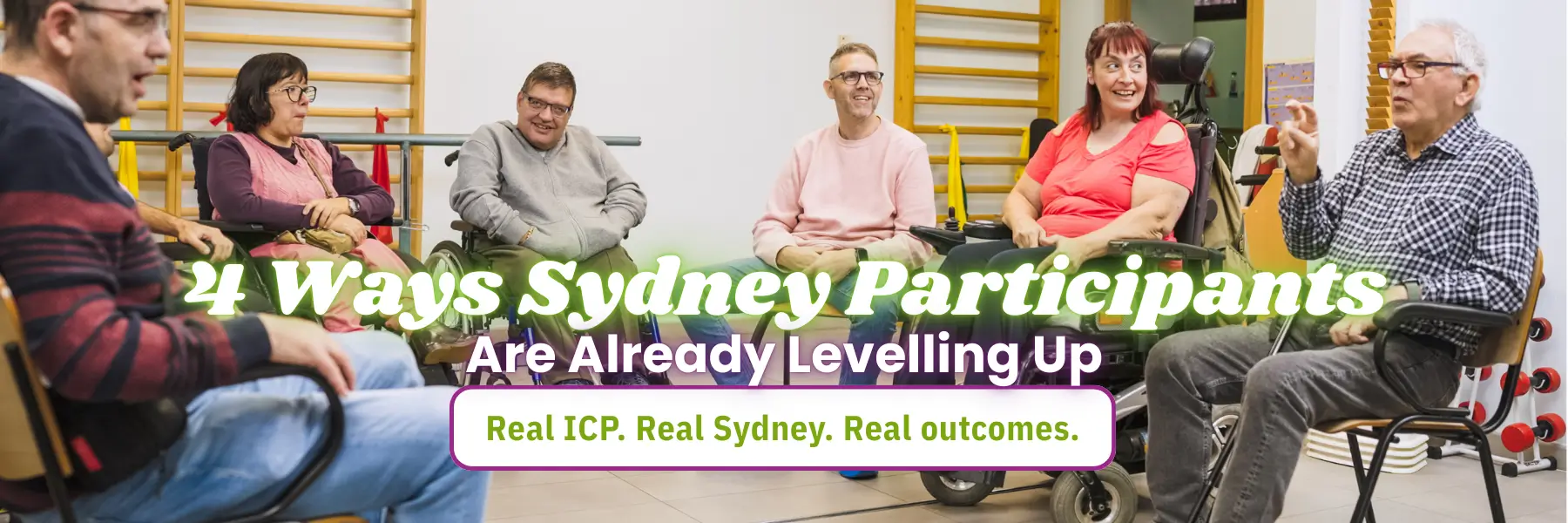
NDIS Innovative Community Participation in Sydney: Real Examples
Greater Sydney has a growing number of providers and programmes that genuinely fit the ICP criteria. Here are four examples of what this looks like in practice:
- Entrepreneurship and business start-up workshops — Structured programmes that teach participants how to register a business, manage finances, and market their services. These programmes are particularly relevant for participants with intellectual disabilities or acquired brain injuries who have identified self-employment as a goal.
- Employment readiness workshops — These go beyond basic job-seeking support. Structured programmes covering résumé writing, interview simulation, digital literacy, and workplace communication help participants build confidence and practical skills for open employment. According to the NDIS Q2 2025–26 Quarterly Report, participants aged 25 to 34 recorded a nine per cent growth in community and social participation outcomes nationally — reflecting increasing ambition for skill-building among working-age participants.
- TAFE NSW supported access programmes — ICP funding can be used to support a participant’s transition into TAFE study, including attending introductory sessions, building study skills, and navigating campus environments with structured mentorship — rather than just with a support worker present.
- Civic volunteering with structured mentorship — Participating in structured volunteering roles at local councils, libraries, or community organisations in Sydney’s western and south-western suburbs, paired with a Community Engagement Practitioner, is a strong ICP use case. The goal is for the participant to sustain the role independently within an agreed timeframe.
These are purposeful, goal-directed, time-bound programmes — quite different from attending a weekly outing, valuable as that is.
Eligibility: What ICP Requires That Standard SCP Does Not
This is where many participants run into confusion at plan reviews. ICP has a higher bar for justification, and it is important to understand this before requesting it.
For ICP to be approved and funded in your NDIS plan, the following must apply:
- Your plan must include a goal directly related to skill-building or community independence — not just a general participation goal
- The programme you are accessing must have a defined skill-building outcome, not simply provide access or attendance
- The support must be time-limited in design — ICP is not intended to fund permanent, ongoing support
- The provider must be able to demonstrate how the programme leads to reduced reliance on paid support over time
- ICP must be reasonable and necessary in the context of your disability and stated goals, consistent with NDIS funding criteria
In short: ICP cannot simply fund attendance at something interesting. It must build capacity that moves you toward greater independence.

How to Request Innovative Community Participation at Your Next NDIS Plan Review in NSW
Many Sydney participants are not accessing ICP simply because they have not asked for it — or because their current goals are not specific enough to support the request. Here is a practical approach ahead of your next plan review or reassessment:
- Identify the skill you want to build — Be specific. “I want to learn how to manage my own business” is far stronger than “I want to participate more in the community.”
- Write that goal into your plan language — Work with your Support Coordinator or LAC to frame your goal in terms of independence and skill development, not just access.
- Gather supporting evidence — A letter from your GP, occupational therapist, or allied health provider outlining why structured skill-building is relevant to your disability can be persuasive.
- Research ICP programmes before your review — If you can name a specific programme and provider in Sydney, your request becomes considerably more concrete and easier for a planner to approve.
- Attend your review prepared — Bring notes, your goal statements, and any supporting correspondence. NSW participants can also work with an advocate from Disability Advocacy NSW if they need support navigating the review process.
If you are not yet sure whether your current goals support an ICP request, our Support Coordination service at ADCS can review your plan with you and identify the best pathway forward.
Why This Distinction Matters Right Now for Sydney Participants
The NDIS landscape is changing. The NDIA’s Q2 2025–26 Quarterly Report noted that overall community and social participation rates across the scheme sat at 41 per cent against an annual target of 43 per cent — signalling that many participants are still not maximising their Capacity Building entitlements (NDIS Quarterly Report Q2 2025–26, ndis.gov.au).
For participants in Greater Sydney — a region with genuine access to employment pathways, TAFE campuses, business incubators, and civic organisations — ICP represents a meaningful opportunity to use NDIS funding for genuine life transformation, not just ongoing support.
At ADCS, we work with participants across Greater Sydney to make sure Capacity Building funding is understood and fully utilised. Whether you are exploring ICP for the first time or want help navigating your community participation goals, our team is here to help.
You can explore our Community Participation services at ADCS or read our related resource on how to navigate the differences between NDIS accommodation and living support options if you are managing multiple support types in your current plan.
For a broader grounding in how NDIS plans are structured, our NDIS Explained guide is a useful starting point, particularly if you are approaching your first plan review.
Ready to level up your NDIS plan? Contact the ADCS team for a no-obligation conversation about your community participation goals.
Frequently Asked Questions
Q1: What is the difference between NDIS Innovative Community Participation and standard Social and Community Participation?
Standard SCP funds ongoing support to attend activities. ICP funds structured, time-limited programmes designed to build transferable skills, such as employment readiness or entrepreneurship — with the goal of reducing reliance on paid support over time.
Q2: Can I have both Social Community Participation and Innovative Community Participation in my NDIS plan at the same time?
Yes. Both sit under the Capacity Building budget and can co-exist in a single plan, provided each is tied to appropriate goals and meets the NDIS reasonable and necessary criteria. A support coordinator can help you structure both effectively.
Q3: Does Innovative Community Participation funding expire if I don’t use it within my plan period?
NDIS Capacity Building funding that is not used within the plan period does not roll over. It is important to identify ICP providers and begin programmes as early as possible in your plan period to make full use of your allocation.