

Yes, the NDIS can pay for cleaning when the help relates to your disability and is funded in your plan. NDIS cleaning services usually come from your Core Supports budget, and the NDIA lists help with cleaning and laundry among the home supports it may fund (NDIS, Guide to your NDIS home and living options, page current as of 17 August 2026). What it does not cover is the everyday cost of running a home, such as rent, groceries and bills.
Below, we walk through where household tasks sit in a plan, what is usually in and out, how hours are set, the price rules providers must follow, and a simple task list that keeps every visit on track.
Where NDIS household tasks sit in your plan
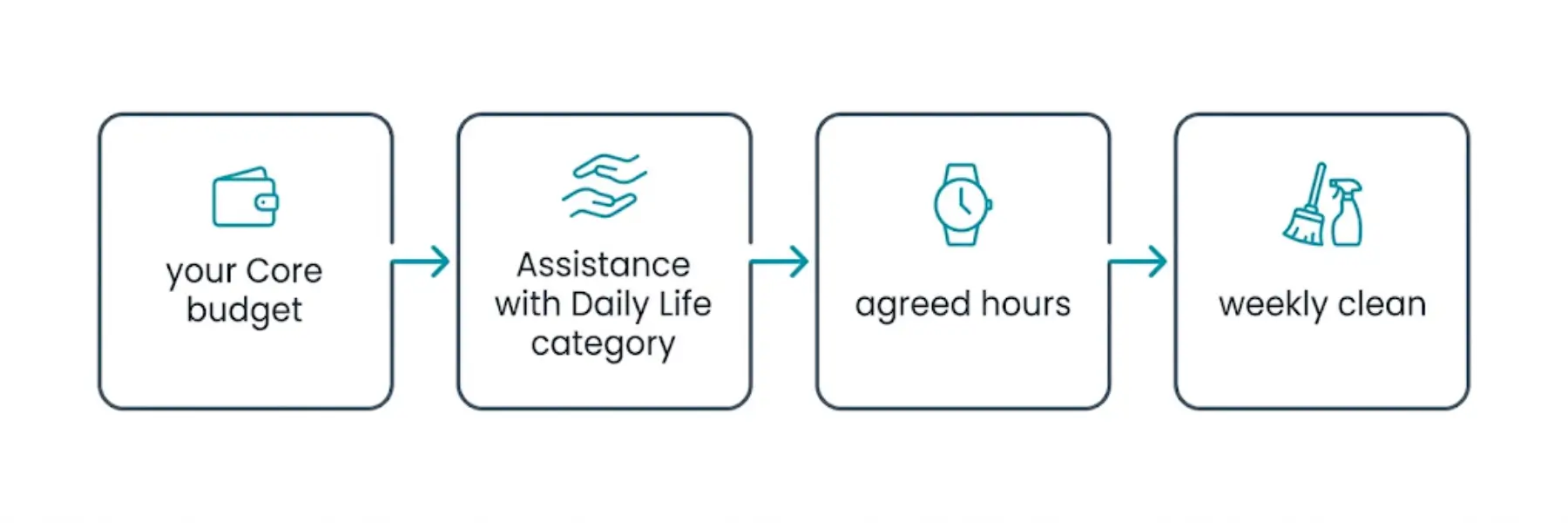
Household tasks are funded through your Core Supports budget, under the Assistance with Daily Life category. A few things are worth knowing:
- It is a budget, not a set number of cleans. Your plan gives you funding to use on the supports you need, rather than a fixed weekly service.
- Core funding is flexible. The NDIA says this funding is flexible with your other core supports, so you have some room to adjust how you use it.
- Support usually happens at home. It often suits people who need targeted help with particular tasks rather than support all day.
Household help often sits alongside personal care and meal preparation as part of daily living support in Sydney, rather than as a stand-alone cleaning service.
NDIS cleaning services: what is generally covered and what is not
The NDIS funds supports that relate to your disability. Household tasks commonly include:
- cleaning bathrooms, toilets and kitchen surfaces
- vacuuming and mopping
- washing dishes and keeping the home safe and tidy
- laundry and changing bed linen
What you pay for yourself. The NDIA says participants are responsible for day-to-day living costs, including rent, groceries, utilities, phone and internet. In most cases, general household items such as a bed, fridge or cooking utensils are also your own cost.
What needs a different conversation:
- Changes to your home, like a modified bathroom, are home modifications. These are a separate support with their own assessment process.
- Bigger yard or maintenance jobs have their own line item for house or yard maintenance, separate from household cleaning.
- A one-off major clean-up, such as clearing a heavily cluttered home, is not routine household help. Talk to your support coordinator or planner before booking anything.
How your hours are decided
Your household task funding is set at your planning meeting, based on your disability-related needs and goals. That is why your plan shows a budget rather than a list of rooms or a number of visits.
In practice, the number of hours you can use depends on two things: the funding in your plan and the hourly price your provider charges.
To help your planner understand what you need, it is worth bringing:
- the household tasks you cannot do safely, and why
- how often each task needs doing
- what happens when tasks are missed, such as hygiene or safety risks
- any reports from your occupational therapist or other professionals
For more on getting ready, read how to prepare for an NDIS plan reassessment.
The price rules providers must follow
The current maximum price for household cleaning is set in the NDIS Pricing Schedule 2026-27, effective 24 September 2026. The support item “House Cleaning And Other Household Activities” (01_020_0120_1_1) has a national maximum of $60.10 per hour. The higher remote rates apply only in remote and very remote areas, so Greater Sydney uses the national price.
What this means for you:
- It is a maximum, not a set fee. Providers can charge less, but not more.
- It applies to NDIA-managed and plan-managed funding. The NDIA says providers cannot charge these participants more than the maximum price.
- Get it in writing. A service agreement sets out what supports you will receive, when, and at what price. The NDIA recommends one every time you start with a new provider.
When the work does not match the hours
This is one of the most common frustrations we hear about. The invoice says three hours, but it does not feel like three hours of work got done. Here is a calm way to sort it out:
- Check your service agreement. It should say what was agreed and how support is delivered.
- Ask for visit notes. Start and finish times, plus a short note on what was done, make things clear for everyone.
- Compare your statements. Check claims in the my NDIS portal or app, or your plan manager’s statements, against the visits you actually had.
- Talk to your provider first. Many issues come down to different ideas about priorities, which a task list fixes quickly.
- Escalate if you need to. You can contact the NDIS Quality and Safeguards Commission on 1800 035 544. If you think funding is being claimed for work that was not done, the NDIS fraud reporting and scams helpline is 1800 650 717.
A task list is the simple fix
A written task list turns “clean the house” into clear priorities. It helps any support worker know what matters most, and it makes it easy to check what was done.
How to build one:
- List the tasks room by room.
- Mark which ones happen every visit and which ones rotate.
- Note anything specific, like products you prefer or items not to move.
- Agree the order with your provider and review it after a few weeks.
Worked example (for illustration only). A weekly three-hour visit in a two-bedroom unit in Parramatta, for someone whose disability makes bending and lifting unsafe:
Every visit:
- clean the bathroom and toilet
- wipe kitchen benches, stovetop and sink
- vacuum and mop the main living areas
- wash and hang out one load of laundry
Rotating, one per week:
- change the bed linen
- clean the microwave and fridge shelves
- wipe down doors and skirting boards
- clean the inside windows in one room
What fits into a visit depends on your home and your needs, so treat this as a starting point rather than a standard.
Some people also want to build their own skills over time, so they can take on lighter tasks themselves. That can be part of the support too, and it is worth raising with your provider when you set up your task list.
How ADCS helps with household tasks in Sydney
ADCS is a registered NDIS disability support provider, not a cleaning company. Household tasks are one part of the wider support our team provides at home, alongside personal care, meals, routines and building everyday skills.
Depending on your plan and your living situation, that support may come through:
- daily living support in Sydney, for help with everyday tasks at home
- home and living support in Sydney, including in-home support
- supported independent living, where support workers help with household tasks in a shared or individual home
For a closer look at what is included, read what daily living support actually covers.
Frequently asked questions
Does the NDIS cover house cleaning?
Yes, when the cleaning relates to your disability and is funded in your plan. It usually comes from your Core Supports budget. The NDIS does not pay for everyday living costs such as rent, groceries or bills.
How many hours of cleaning will the NDIS fund?
There is no set number. Your funding is based on your disability-related needs and goals at planning, and the hours you can use depend on that budget and your provider’s hourly price.
What should a cleaner do in 3 hours?
There is no official list, because every home and every person is different. The best approach is to agree a written task list with your provider, with must-do tasks each visit and other tasks on rotation.
Can I choose my own cleaner?
Yes, you choose who delivers your supports. If your plan is NDIA-managed, you need to use registered providers. Plan-managed and self-managed participants currently have more options, although the NDIA says registration requirements will expand from July 2027 for providers of personal care and daily living supports. Whoever you choose, put the tasks and price in a service agreement.
Is cleaning different in supported independent living?
In supported independent living, support workers may help with daily tasks at home, including cleaning, cooking and shopping, as part of your SIL support. Rent and household bills are still your own costs.
Talk to ADCS about support at home
Sorting out household help can feel like a lot of admin when you just want a home that works for you. Our team can help you understand what your plan covers, put together a task list that suits your home and fit household tasks into your wider daily living support.
Get in touch with the ADCS team about daily living support in Sydney to book a time that suits you. You can also learn more about us as a registered NDIS provider in Sydney.
