

The NDIS bill 2026 passed Parliament in August, and the first funding changes started on 1 October 2026. So what does that mean for your plan? Nothing shifts overnight. For most participants, the changes only show up at their next plan review.
Below, we focus on the practical side: when each stage starts, who it affects first and what it means for social and community participation budgets, explained the way we’d talk it through with you in our office.
What the NDIS Bill 2026 actually is
The law’s full name is the National Disability Insurance Scheme Amendment (Securing the NDIS for Future Generations) Bill 2026. It passed Parliament on 19 August 2026 and was signed by the Governor-General on 20 August 2026, when it became an Act (NDIS, Securing the NDIS for future generations, page current as of 1 October 2026).
The NDIS legislation changes cover four broad areas:
- who can access the NDIS
- how plans are managed
- how funding can be used
- how providers operate and are overseen
Here’s the reassuring part. Right now, the NDIA says you can keep using your plan and supports as usual, and it will contact you directly if a change affects you.
The timeline: what starts when
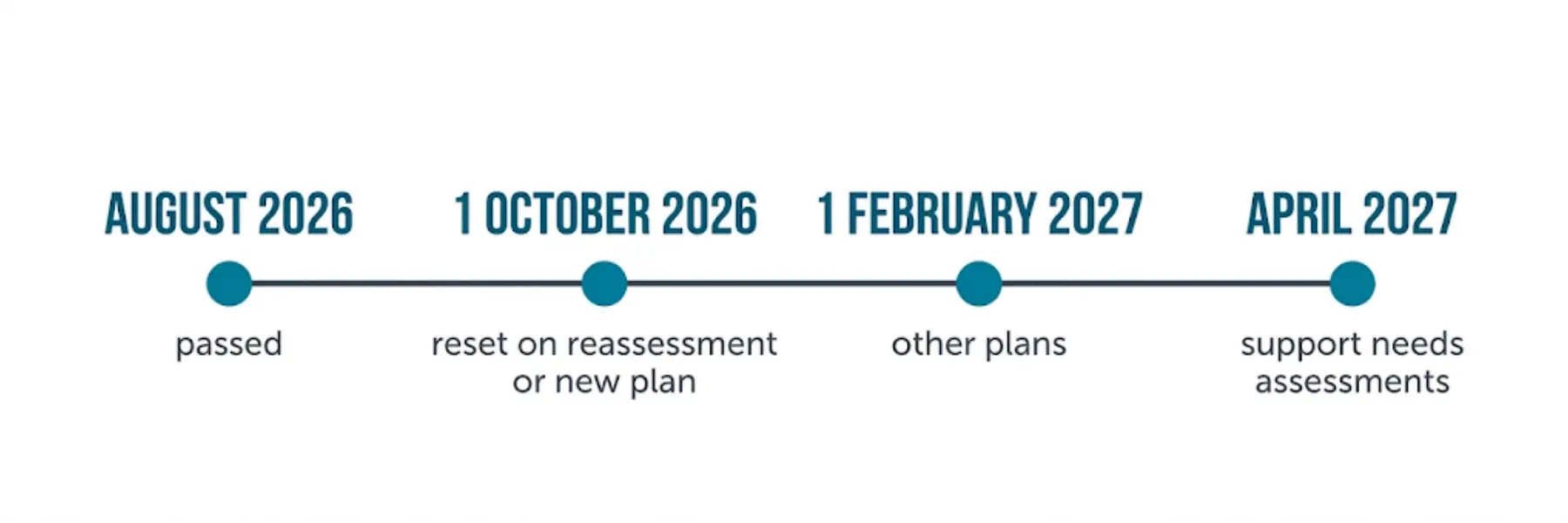
This is the official sequence for participants, as published by the NDIA (page current as of 1 October 2026):
- 19 August 2026: the Amendment Bill passes Parliament.
- 27 August 2026: the first changes commence, including tighter rules on who can ask for an early plan reassessment.
- 1 October 2026: support budget reductions begin when a plan is reassessed or a new plan is approved. The NDIA can also suspend a plan if a participant does not respond to requests for information, but only after at least five contact attempts over three to four months.
- December 2026: claims must be submitted within 90 days of delivering a support.
- 1 February 2027: reductions begin when a plan is renewed. “Plan renewals” replace plan continuations, and unspent funds from the old plan will not carry over.
- April 2027: the new way of planning begins, with budgets informed by a support needs assessment.
- January 2028: access changes begin for new applicants. There are no changes to NDIS access arrangements before 1 January 2028.
What the “reset” means for your participation budget
So what does “reset” actually mean? In the NDIA’s words, budgets for social, economic and community participation supports, and for improved daily living skills, will be reduced as plans are reassessed or renewed. The change is eased in over 12 months rather than all at once.
In practical terms:
- It is not overnight. Nothing changes until your plan is reassessed, a new plan is approved, or (from February 2027) your plan is renewed.
- It is phased. The reduction is spread over a 12-month period rather than applied in one step.
- There is no single official figure for every plan. You may have seen percentages shared online. The NDIA has not published one number that applies to everyone, so we will not guess what any individual plan will look like.
- Plans still move for ordinary reasons. The NDIA notes plans can go up or down as needs change, separate from the reforms.
Some supports are protected from these reductions. Funding for help with eating and drinking, education supports, employment supports and disability-related health supports is not affected. Participants who need 24-hour disability support will also have a new pathway to apply for a plan variation within 90 days of the change applying to them.
Who is affected first, and what is not changing yet
First: participants whose plan is reassessed, or who receive a new plan, from 1 October 2026.
Later: participants whose plan is renewed from 1 February 2027.
Not changing yet:
- your current plan, until it is reassessed or renewed
- NDIS access arrangements, which stay the same until at least 1 January 2028
- NDIS pricing, with providers continuing to follow the current Pricing Arrangements
- your right to request a plan change if your functional capacity or circumstances change significantly
For perspective, this touches a lot of local families. New South Wales has the largest group of participants in the country: 230,427 people with an active plan, or 29.5% of the scheme, as at 30 June 2026 (NDIS Quarterly Report, June 2026). That includes families right across Greater Sydney, from Penrith to the Eastern Suburbs.
Where community participation fits in
Community participation is the budget line these NDIS changes for October 2026 touch first, and it is the heart of what we do at ADCS. The goal during the transition is simple: make every funded hour count towards a goal you can describe and show.
Practical ways to do that:
- Favour activities that build a skill. Our group centre activities and life skills groups (cooking, budgeting, travel training) are designed around goals, not just filling a day.
- Link daily living to your plan goals. If your plan funds improved daily living skills, our daily living support programs can focus on the specific tasks you want to do independently.
- Keep a simple progress log. For example, if your goal is to catch the train from Fairfield to a weekly activity on your own, note when you first needed full support and when you started doing parts of the trip alone.
- Ask your provider for written updates. Short progress notes from support workers are useful evidence at a reassessment.
If you want ideas, our guide to 10 NDIS-funded community activities in Sydney shows how activities connect to plan goals. You can also read more about our community participation support in Sydney.
What a support coordinator can and cannot do during a reassessment
This is where a support coordinator can really make life easier. It helps to know what they can take off your plate, and where their role stops.
A support coordinator can:
- explain your plan, your dates and how the new rules apply to your situation
- help you gather reports and evidence that describe your day-to-day support needs
- help you prepare for, and attend, your planning conversation
- connect you with providers that suit your goals and budget
- help you request a plan variation or a review of a decision if needed
A support coordinator cannot:
- decide your funding, which is the NDIA’s role
- promise a particular outcome
- predict the exact dollar amount in your next plan
If you would like that support, talk to us about support coordination in Sydney. For a step-by-step approach, read how to prepare for an NDIS plan reassessment.
A short checklist before your next plan review
- Log in to the my NDIS portal and note your plan reassessment date. The NDIA is still updating its guidance to reflect the new laws, so the portal is your most reliable source for your own plan.
- Check your contact details are current, so you do not miss NDIA requests for information.
- Collect recent reports that describe how your disability affects everyday life.
- Write down which supports are helping you reach your goals, and why.
- Keep records of supports and payments. Under the new laws, participants will soon need to keep these records for three years.
- Read why your NDIS invoice looks different, so your statements make sense.
Frequently asked questions
Will my NDIS plan be cut?
It depends on what’s in your plan. If it includes social, economic or community participation supports, or improved daily living skills, those budgets will be gradually reduced over 12 months once your plan is reassessed, replaced or renewed. There’s no single official figure that applies to everyone, and some supports aren’t affected at all, including help with eating and drinking, education, employment and disability-related health supports.
When do the NDIS changes start?
The first changes began on 1 October 2026, but only for plans reassessed or newly approved from that date. Plans renewed from 1 February 2027 come next, and the new way of planning starts in April 2027. If your review is a while off, you have time to get ready.
Do I need new evidence?
Not automatically. That said, up-to-date reports showing how your disability affects everyday life, along with a few notes on how your supports are helping, can make your next review much smoother.
Who do I ask about my own plan?
For questions about your own plan, the NDIA (1800 800 110) and the my NDIS portal are the best places to start. You don’t have to work it out alone, though. Your support coordinator, Local Area Coordinator or provider can talk it through with you and help you prepare.
Can I still use my community participation supports right now?
Yes. The NDIA says you can keep using your plan and supports as usual. Any reduction only applies once your plan is reassessed, replaced or renewed, so your current activities and supports carry on until then.
What if I need 24-hour support?
The NDIA is setting up a separate plan variation pathway for participants who need 24-hour disability support. You’ll be able to apply within 90 days of the change applying to you, and it’s designed to help you keep the supports you rely on at home.
Talk to ADCS before your next plan review
We know a review letter can feel a bit daunting, especially with so much talk about the changes. As a registered NDIS provider in Sydney, we’re here to help you make sense of your timeline, get your paperwork in order and choose community participation and daily living supports that suit your goals.
Get in touch with our team to book a time before your next plan review. Even a short chat now can make the review feel a lot more manageable.
